
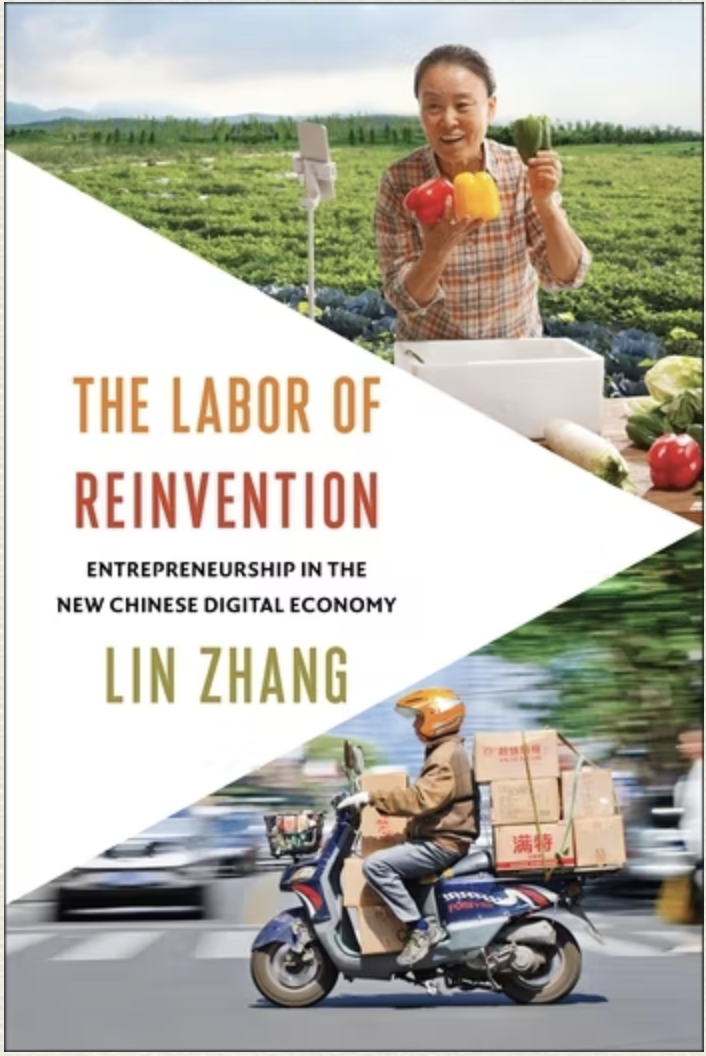
The Labor of Reinvention: Entrepreneurship in the New Chinese Digital Economy (Columbia University Press, March 2023)
From start-up founders in the Chinese equivalent of Silicon Valley to rural villages experiencing an e-commerce boom to middle-class women reselling luxury goods, the rise of internet-based entrepreneurship has affected every part of China. For many, reinventing oneself as an entrepreneur has appeared to be an appealing way to adapt to a changing economy and society. Yet in practice, digital entrepreneurship has also reinforced traditional Chinese ideas about state power, labor, gender, and identity.
Lin Zhang explores how the everyday labor of entrepreneurial reinvention is remaking China amid changing geopolitical currents. She tells the stories of people from diverse class, gender, and age backgrounds across rural, urban, and transnational settings in rich detail, providing a multifaceted and ground-level view of the twenty-first-century Chinese economy. Zhang explores the surge in digital entrepreneurialism against the backdrop of global financial crises, the U.S.-China trade war, and the COVID-19 pandemic. She argues that the rise of internet-based industries and practices has simultaneously empowered and exploited digital entrepreneurs and laborers. Despite embracing high-tech innovation, state-led entrepreneurialization does not represent a radical break with the past. It has provided a means for implementing developmental goals while retaining the importance of the traditional family and generating new inequalities.
Shedding new light on global capitalism and the digital economy by centering a non-Western perspective, The Labor of Reinvention vividly conveys how the contradictions of entrepreneurialism have played out in China.
- Listed as one of the best books of the year by FOUCS https://focus.cbbc.org/best-china-books-2023/
- Reviewed in Asian Review of Books
- Reviewed in Eurasian Geography and Economics
- Reviewed in the International Journal of Communication
- Reviewed in The China Quarterly
- Reviewed in The Communication Review
- Reviewed in The European Journal of Cultural Studies
- Review in Réseaux
- Reviewed in the Chinese Journal of Communication
- Reviewed in The Thinker
- Reviewed in Pacific Affairs
- Reviewed in the Journal of Asian Studies
New Book Project
My current monograph, tentatively titled Circulating Innovation: Transnational Biotech and the Globalization of China, is envisioned as a crossover academic book with the potential to engage a broader public readership. Building on my research in innovation, global social justice, and transnational knowledge work, this book presents a three-part narrative of global China. It explores how ethnic Chinese knowledge workers, scientists, entrepreneurs, investors, and policymakers navigate and reshape the evolving landscape of globalization through the lens of the transnational biomedical sector. Grounded in multi-sited ethnographic research and in-depth interviews with industry practitioners, the book traces the transnational circulation of bodies, knowledge, capital, and policy ideas. It connects major global biomedical centers, including Boston and California in the US, Chinese biomedical hubs such as Shanghai/Suzhou, the Greater Bay Area, and Chengdu, as well as emerging biomedical sites in the Global South, such as Jakarta, Indonesia.
To follow my ongoing research for this book, please subscribe to this newsletter, Circulating Innovation
 Lin Zhang